Monday, 22 February 2021

Investigating sensory processing in children with rare genetic syndromes

Rare Diseases Day

How we process the world around us through our senses is essential to
almost everything we do. When eating a meal our eyes and nose tell us what we are about to eat, our mouths inform us about the taste and texture of the food, our touch receptors and feedback from our limbs allow us to hold and use the knife and fork, and our ears detect the voices around the table. Our different sensory systems are continuously filtering the important information from the non-important information, allowing us to respond accordingly. Most of the time our brains and bodies are processing all of this information without us even noticing.


The eight sensory modalities
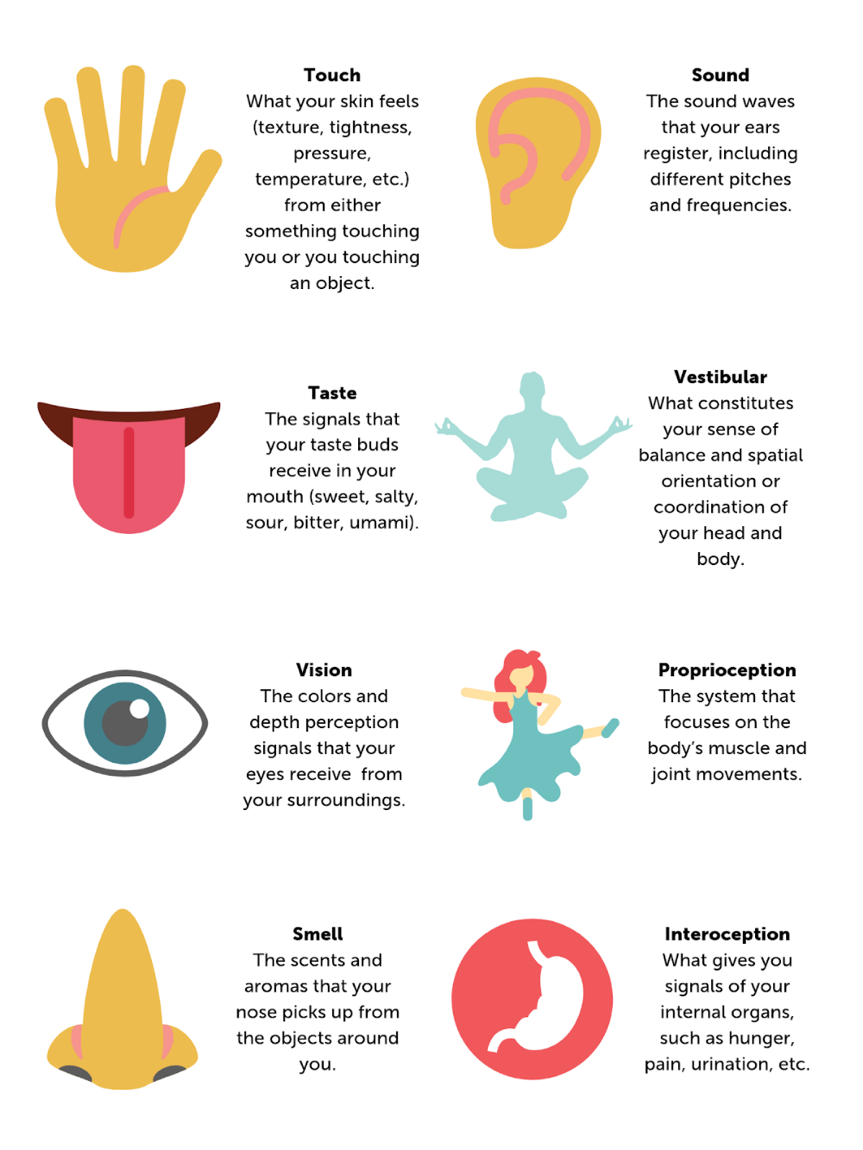


Image result for eight sensory systems infographic


Children with sensory processing differences experience the world differently to others     . Sometimes, these differences mean children face challenges in their participation in everyday activities or in certain environments. Some children require more sensory input to detect a sensory experience (e.g., they may seem unaware of temperature changes) or they may seek out sensory input to meet their sensory needs (e.g., they may display a need to touch objects, surfaces or textures). Children may have increased sensitivity to sensory input (e.g,. they struggle to focus on a task in background noise) or they may become easily overwhelmed or avoid certain sensory experiences altogether (e.g., they refuse to go to the park because it’s noisy). Sensory processing differences can be highly individual and varied and different responses to sensory input can occur across different sensory modalities (e.g., a child may be over-sensitive to touch but under-sensitive to sound). Sensory difficulties can have a profound effect on daily life and have been associated with decreased activity, decreased school and social participation, increased anxiety, challenging behaviours, and poorer cognitive outcomes. Certain strategies can be used to support children’s participation by removing disruptive sensory input, helping children get the sensory input they are seeking, or by helping children build tolerance towards certain types of sensory input.

Previous research has shown children with rare genetic syndromes; Sotos syndrome, Tatton-Brown Rahman Syndrome, 16p11.2 deletion syndrome, and 16p11.2 duplication syndrome, commonly display autistic traits which may increase the likelihood of sensory processing differences. Compared to more common conditions, there is very limited research on the experiences of children with these syndromes. A better understanding of children’s experiences and potential difficulties is needed to provide information and support for children with rare genetic syndromes and their families. To date, no research has investigated the presence or type of sensory differences in any of these syndromes.

Our new research study, the Sensory Profiles in Rare Genetic Syndromes study will investigate the sensory processing of children aged 3-14 years old with Sotos syndrome, Tatton-Brown Rahman Syndrome, 16p11.2 deletion syndrome, and 16p11.2 duplication syndrome. The study will use a specially-developed questionnaire (completed by a parent or caregiver) to measure children’s sensory processing across the different sensory modalities (i.e. their “Sensory Profile”). The study will also include questionnaires to assess other aspects of behaviour that may be linked to sensory processing differences.

We hope that this research will provide important information that will support families of children with rare genetic syndromes and professionals who work with children with rare genetic syndromes. Understanding particular sensory differences can inform tailored strategies or treatment approaches to support children and families.

Parents or caregivers of children aged 8 to 14 years old with Sotos syndrome, Tatton-Brown Rahman Syndrome, 16p11.2 deletion syndrome, or 16p11.2 duplication syndrome can take part in the study from home. The questionnaires can be completed online or by post and the study is open to participants worldwide. Parents and caregivers will receive a summary of their child’s sensory profile after they take part. If you would like to find out more about the study or if you would like to sign up to take part, complete our contact form or email harriet.smith@sheffield.ac.uk.


You can find articles on ShARL’s previous work on these rare genetic syndromes below. Please email us at sharl@sheffield.ac.uk if you would like copies:

  1. Lane, C., Tatton-Brown, K., & Freeth, M. (2020) Tatton-Brown-Rahman syndrome : cognitive and behavioural phenotypes. Developmental Medicine & Child Neurology, 62(8), 993-998
  2. Al-Jawahiri, R., Jones, M., & Milne, E. (2020). Spontaneous neural activity relates to psychiatric traits in 16p11. 2 CNV carriers: An analysis of EEG spectral power and multiscale entropy. Journal of Psychiatric Research.
  3. Al-Jawahiri, R., Jones, M., & Milne, E. (2019). Atypical neural variability in carriers of 16p11.2 copy number variants Autism Research, 12(9), 1322-1333.
  4. Lane, C., van Herwegen, J., & Freeth, M. (2019).      Exploring the approximate number system in Sotos syndrome: Insights from a dot comparison task Journal of Intellectual Disability Research, 63(8), 917-925
  5. Lane, C., van Herwegen, J., & Freeth, M. (2019).      Parent-reported communication abilities of children with Sotos syndrome: Evidence from the Children's Communication Checklist-2. Journal of Autism and Developmental Disorders, 49(4), 1475-1483
  6. Lane, C., Milne, E., & Freeth, M. (2019).      The Cognitive Profile of Sotos Syndrome. Journal of Neuropsychology, 13(2), 240-252    
  1. Lane, C., Milne, E., & Freeth, M. (2017).      Characteristics of Autism Spectrum Disorder in Sotos Syndrome. Journal of Autism and Developmental Disorders, 47(1), 135-143.


Thursday, 18 February 2021

Genetic syndromes research at ShARL

For Rare Diseases Day 2021 we are publishing a series of blogs about the research on rare genetic syndromes that we do at ShARL. We started our research on rare genetic syndromes in 2014. At this time we realised that although there is a lot of medical and genetic research that improves understanding of rare genetic syndromes, there is far less that aims to improve knowledge and understanding of the impact of syndromes on cognition (how we think and learn) and behaviour. It is really important for families that this type of work is done so that when a diagnosis of a particular syndrome is received, they can be equiped with knowledge about what to expect in terms of development and learn about what educational and environmental support may help children to have optimal life chances and optimal outcomes.

At ShARL we are really passionate about doing work that will help families and we are always keen to hear from families about the types of research they would like to see done. We realise that families often have many unanswered questions and that it can be frustrating when even the specialists don't have clear answers for them, so this is something that we're trying to contribute to improving. To date, we have projects that focus on Sotos syndrome, Tatton-Brown Rahman syndrome, Weaver syndrome, Silver-Russell syndrome, 16p11.2 duplication syndrome, 16p11.2 deletion syndrome, 22q11 deletion syndrome. The projects that we're able to run depend on being able to acquire funding to do so but we're always looking for funding opportunities and organisations to work with to enable projects to run.

In this first blog in our series for Rare Diseases Day 2021 we don't have space to write about all of our work so, instead, I've decided to focus on the syndrome we've published most work on so far. Hopefully this brief overview provides some insight into the types of questions we can answer from our lab doing this type of research. In future we hope to both improve understanding further on the syndromes we have already been working on and to also do research on other syndromes for which there is little current knowledge.

Our research on Sotos syndrome


We began our rare genetic syndromes work on a condition called Sotos syndrome. Much of this work has been funded by the Child Growth Foundation and we
have also recieved support from the Baily Thomas Chaitable Fund. This work was led by Dr Chloe Lane. 

Sotos syndrome is an overgrowth disorder which is present from birth. Individuals with Sotos syndrome tend to have an enlarged head circumferance, characteristic facial features and some degree of intellectual disability. It is caused by haploinsufficiency of the NSD1 gene on chromosome 5. It affects males and females equally and in the majority of cases the NSD1 abnormalities that cause Sotos syndrome are "de novo" meaning that they occur spontaneously and the condition is not inherited.

One of our research projects on Sotos syndrome investigated whether there is a specific learning profile associated with the syndrome, i.e. whether there is a consistent profile of relative strengths and difficulties. We found that while those with Sotos syndrome tend to be of overall lower ability than children of the same age, they tend to have relative strengths with verbal skills (both speaking and understanding) but relative difficulty with non-verbal reasoning skills. They tend to have strengths in visuo-spatial memory, so things like remembering routes traveled and where to find things can be a strength. In a piece of research that specifically focused on the different aspects of language we found that while understanding of sentences and vocabulary tends to be quite good, sometimes this may not be apparent during conversations as the social aspects of language, such as turn-taking, using non-verbal cues such as eye-gaze direction or using language in appropriate contexts can be a challenge. Some of these difficulties are also experienced by individuals on the autistic spectrum. So, in another piece of research we investigated how common it is for individuals with Sotos syndrome to display autistic traits. We found that it is really common for those with Sotos syndrome to display autistic traits, with most expressing traits at the "clinically relevant" level. An area of life that individuals with Sotos syndrome find particularly challenging is managing finance and dealing with numbers in general. So, in another piece of research we decided to investigate whether there were any underlying reasons why this might be. We found that those with Sotos syndrome tend to have good estimation skills (termed the "approximate number system") but they have difficulties with impulse control and this may be impairing their maths skills development. In future, it will be important to investigate how this aspect of development can be best supported in order to help children with Sotos syndrome acquire these important numerical skills.

Although quite a brief whistle-stop tour, I hope this overview provides some insight into the sorts of projects we do at ShARL. We will share outcomes of our future projects as they progress and there will be more information about these projects as part of this blog series. If you would like access to any of the research written about in this blog, please email me (m.freeth@sheffield.ac.uk) and I'll be happy to share it directly. Further information on all of the work that we do at ShARL is available on our website.

Thank you for reading!

Dr Megan Freeth

Senior Lecturer in Psychology

Director of the Sheffield Autism Research Lab


Thursday, 6 June 2019

‘I was exhausted trying to figure it out’: The experiences of females receiving an autism diagnosis in middle to late adulthood


Research Summary

 
We recently published a paper in the journal Autism that focused on the lived experienced of women who did not receive their autism diagnosis until the age of 40 or above. We found that individuals in this traditionally under-represented group had lots of shared experiences. We hope that their generosity in sharing their experiences will help to improve societal understanding - there is a long way to go. The article is currently Open Access so just click here for the full article. The project is summarised below: 
 
Autism Spectrum Condition (ASC) diagnoses often occur later for females than for males. So, many females’ needs are not understood until later in life.  This means that they cannot be supported in the most helpful ways. There is little research asking autistic females about their experiences. Therefore, we conducted a research project about this.  Our research investigated the experiences of 11 females diagnosed with ASC when they were aged 40 years or older. The answers to the interview questions were analysed using a research method called Interpretative Phenomenological Analysis. This research method allows researchers to gather detailed information about individuals and their specific life experiences in relation to a certain topic or event.  The analysis involves using psychological understandings to interpret what individuals have said and to summarise this in a helpful way for their stories to be heard. 
 
Our results showed that ASC seemed to be misunderstood by several groups of people. Before they were diagnosed, the females we interviewed had used strategies to try to ‘fit in’ with others. Many had been previously given other diagnoses (e.g., mental health conditions such as Borderline Personality Disorder and complex trauma) that were incorrect.  This made life very difficult and many of the females in this research experienced significant difficulties with their mental health.  After the diagnosis of ASC, the females described experiences of grief and sadness as they thought about how difficult their life had been before.  The process of getting used to their new diagnosis was influenced both positively and negatively by other people.  After the diagnosis, many of the females experienced positive changes in their relationships and they began to accept themselves for who they were, rather than trying to change to ‘fit in’. Some of the females also felt that they had increased control over their lives.  The research suggests that a diagnosis in earlier life could have prevented these females having such difficult life experiences.  This research demonstrates that mental health services and schools require training to better understand ASC in females. 

Full article reference:

Leedham, A., Thompson, A., Smith, R., & Freeth, M. (in press).  ‘I was exhausted trying to figure it out’: The experiences of females receiving an autism diagnosis in middle to late adulthood. Autism 

Monday, 10 December 2018


Communicationabilities of children with Sotos Syndrome: Research Summary

Chloe Lane, Jo van Herwegen & Megan Freeth


Sotos syndrome is a congenital overgrowth syndrome associated with intellectual disability. Previous research has reported that individuals with Sotos syndrome often have communication impairments and delayed language development. However, the nature of these difficulties has not been explored in detail. Language and communication skills are fundamental for human interaction. Effective communication can facilitate learning and enable individuals to share information and ideas so it is important to identify the extent to which children with Sotos syndrome struggle with language and communication, as difficulties may impact upon learning and social development.

Two important communicative abilities are language structure and pragmatic language. Language structure refers to understanding the rules governing language, such as the ability to construct coherent sentences in which words are used in the correct order. Pragmatic language involves understanding how to use language appropriately, such as using language that is appropriate to the context. Some individuals may have better language structure skills or pragmatic language skills, so difficulty with one does not necessarily mean that an individual will also struggle with the other. To date, these communication skills have not been investigated in individuals with Sotos syndrome. So, the aim of our research was to establish whether children with Sotos syndrome have difficulty with these skills and if so, whether particular aspects of language and communication are more problematic than others.

 
Our study included 31 children with a diagnosis of Sotos syndrome, ranging in age from 4 – 16 years. Communication abilities were assessed using a questionnaire (The Children’s Communication Checklist, second edition (CCC-2)), which was completed by the parent or caregiver of each child. The CCC-2 has 70 questions which are designed to assess a range of communication abilities, including both language structure skills and pragmatic language skills, as well as social relations and restricted interests.

 In terms of overall communication skills, the findings identified that the majority of children with Sotos syndrome were reported by their parent or caregiver as having difficulties with language and communication. This was defined as having greater difficulty with language and communication than typically developing peers of the same age (children the same age with no diagnosed conditions). There was no difference between overall language structure skills and overall pragmatic language skills, indicating that children with Sotos syndrome have similar difficulty with both of these aspects of language and communication. Furthermore, the findings identified that language structure skills predict pragmatic language skills, meaning that better language structure skills result in better pragmatic language skills for children with Sotos syndrome.


Four specific language structure skills (speech, syntax, semantics and coherence) were compared in order to see whether children with Sotos syndrome had particular difficulty with any of these specific skills. The findings indicated that the participants were reported as having a similar degree of difficulty with all of the skills. Comparisons were also made between the four specific pragmatic language skills (inappropriate initiation, stereotyped language, use of context and nonverbal communication). The findings identified that children with Sotos syndrome were reported as having greater difficulty with use of context and nonverbal communication, compared with inappropriate initiation and stereotyped language. Furthermore, participants were reported as having particular difficulty with social relations.

Overall, the findings from this research demonstrate that the majority of children with Sotos syndrome struggle with language and communication skills and will therefore require support with the development of these skills. In particular, children with Sotos syndrome have difficulty with the consistency of communication across different situations, with understanding and using nonverbal communication, such as eye contact, gestures and facial expressions and with forming and maintaining relationships with peers.

 
For the full paper, please see:

Lane, C., Van Herwegen, J. & Freeth, M. (in press). Parent-reported communication abilities of children with Sotossyndrome: Evidence from the Children’s Communication Checklist-2. Journal of autism and developmental disorders. doi:10.1007/s10803-018-3842-0

Thursday, 31 May 2018

Autistic people's perspectives on stereotypes


Summary of our new research paper, published in Autism


Stereotypes are society’s beliefs about group members. People often use stereotypes to inform the impressions they make of others. In this study we asked autistic people how they think they are perceived by others and what they think the autistic stereotypes are. It is important to know how autistic people think that they are perceived by others as this helps us to understand the nature of autistic people’s experiences. To do this we interviewed twelve autistic adults and analysed the data using Interpretative Phenomenological Analysis (IPA). IPA is an approach that enabled the researchers to find out about and understand autistic people’s lived experiences. Three main themes emerged from the analysis of the interviews. These were: (1) The primary stereotype is that autistic people are ‘weird’, (2) Autistic stereotypes have negative effects and consequences and (3) Autistic people are heterogeneous.  
Our findings indicate that negative perceptions of autistic people may lead to negative, prejudiced, behaviour if these negative perceptions are not challenged. One participant expressed frustration with how restrictive stereotypes can be, in that if autistic people behave in a manner that is considered to be counter-stereotypic, then they may not be considered autistic at all. Our study highlights that if autistic people were to internalise the negative stereotypes of autism they perceive, or believe them to be true, this will likely have a negative impact on their self-identity and behaviour. Participants tended to express the view that their autism was only one small part of autism. Some participants felt that they fit the stereotypes they described, or that certain autistic stereotypes may be accurate. However, some autistic people felt that they only identified with certain stereotypical traits, or none at all. The study therefore demonstrates the importance of viewing autistic people as individuals who experience shared traits but who are also diverse and unique.
Please e-mail Caroline Treweek (soa05cat@sheffield.ac.uk) or Megan Freeth (m.freeth@sheffield.ac.uk) for a copy of the paper.


Friday, 16 February 2018

Eye-tracking face-to-face conversations with autistic adults

Summary of our new research paper


Effective communication involves attending to both verbal and non-verbal cues, such as facial expressions and gaze direction. Faces can convey a person’s thoughts and intentions or their emotional and mental state. In this study we investigated whether some of this information tends to be missed by autistic adults during a face-to-face conversation. An experimenter systematically modified her gaze direction between looking directly at a participant’s eyes or averting her gaze away from the participant’s face at pre-determined points during a face-to-face conversation with a participant. The participant wore an eye-tracking device which assessed exactly where they were looking.
 
We found that when the experimenter looked directly at the participant’s eyes, autistic adults tended to look at the experimenter’s face less than neurotypical adults did. However, when the experimenter averted her gaze, differences between groups in how much attention was directed to the face were minimal. Neurotypical adults had a distinct preference for the eyes vs. the mouth but autistic adults did not. Both groups tended to increase looks to the face when listening compared to speaking, indicating similar spontaneous conversation-phase attention modification. A particularly striking finding was how much attention strategies of autistic adults differed from one another. While some autistic adults’ social attention was at least as much as neurotypical adults, others made very little eye-contact throughout the whole conversation.
Our findings suggest that looking directly at an autistic adult’s eyes when having a conversation can cause them to miss opportunities, that they may otherwise take, to attend to information on a face.

Read the full article